|
The Division of Water Resources (DWR) provides the data contained within this
Local Water Supply Plan (LWSP) as a courtesy and service to our customers.
DWR staff does not field verify data. Neither DWR, nor any other party
involved in the preparation of this LWSP attests that the data is completely
free of errors and omissions. Furthermore, data users are cautioned that
LWSPs labeled PROVISIONAL have yet to be reviewed by DWR staff. Subsequent
review may result in significant revision. Questions regarding the accuracy
or limitations of usage of this data should be directed to the water system
and/or DWR.
1. System Information
Contact Information
Provisional
| Water System Name: |
Two Rivers Utilities/Gastonia |
|
PWSID: |
01-36-010 |
| Mailing Address: | P.O. Box 1748
Gastonia, NC 28053 | Ownership: | Municipality |
| |
| Contact Person: | Kyle Butler | Title: | Utilities Engineer |
| Phone: | 704-866-6768 | Cell/Mobile: | 704-214-9078 |
Distribution System
| Line Type |
Size Range (Inches) |
Estimated % of lines |
| Asbestos Cement |
2-36 |
14.48 % |
| Cast Iron |
2-30 |
18.10 % |
| Ductile Iron |
2-54 |
24.76 % |
| Galvanized Iron |
2-14 |
5.89 % |
| Other |
All |
0.34 % |
| Polyvinyl Chloride |
2-24 |
36.43 % |
We reported 714 estimated total miles of water lines in the 2024 LWSP update. Based on updates to GIS for multiple projects such as the recent completion of a 1 to 1 GIS based Water Model, Lead Service line investigations, and the AMI water meter project, we are updating the estimated mileage to reflect the current state of our GIS information. We have also removed 12.65 miles of abandoned water lines our estimated total. We believe the abandoned lines may have been included in previous LWSP updates. The estimated percentages have also been updated to better reflect information logged in our GIS. Approximately 229 miles of the 696 miles of water are of unknown material. This mileage has been proportioned to each of the Line Types based on their weighted percentage against the total mileage of known pipe material.
The number of feet of new water lines added during 2025 is based off fixed asset & final acceptance reports that are generated when new waterlines are accepted by the City for maintenance (most often as a result of private development projects). The mileage listed represents final acceptance reports issued in 2025.
The 900 meters replaced in 2025 is the estimated number of meters replaced by City of Gastonia staff. We anticipate improved reporting with the new work order management system that the City will deploy in 2026. In addition, the contractor for the City's AMI conversion project will be replacing all non-AMI capable water meters over the next 3 years. Beta phase meter replacement will begin in summer 2026 with full deployment starting later in the year. Programs
The City of Gastonia typically utilizes a valve exercise program to maintain valves throughout the year. In the valve exercise program was temporarily suspended due to fluctuations in staffing and maintenance to the valve exercise equipment and vehicles. The program will resume in 2026.
Water Treatment Plant staff flow hydrants as needed for water quality.
The fire department performs static pressure tests on hydrants throughout the year and reports any operational issues to our Utilities Maintenance Division for repairs.
We are currently working on a project to implement an AMI system. As a part of the project all existing water meters are to be replaced with AMI capable water meters. Water Conservation
2. Water Use Information
Service Area
| Sub-Basin(s) | % of Service Population |
|---|
| South Fork Catawba River (03-2) | 67 % |
| Catawba River (03-1) | 33 % |
|
| County(s) | % of Service Population |
|---|
| Gaston | 100 % |
|
The year-round population is based on the most recent OSBM Municipal Certified Population estimates for Gastonia (85,636) and Cramerton (5,819) plus 2.51 persons per each of the 2,096 outside residential water accounts (5,261). Water Use by Type
| Type of Use |
Metered
Connections |
Metered
Average Use (MGD) |
Non-Metered
Connections |
Non-Metered
Estimated Use (MGD) |
| Residential |
32,886 |
4.5543 |
3 |
0.0001 |
| Commercial |
3,025 |
2.1606 |
23 |
0.0939 |
| Industrial |
124 |
0.6278 |
0 |
0.0000 |
| Institutional |
203 |
0.6069 |
0 |
0.0000 |
How much water was used for system processes (backwash, line cleaning, flushing, etc.)? 6.1937 MGD
Non-metered connections are for permitted hydrant usage for filling pools or water for construction sites that are billed through miscellaneous invoice. The Residential Non-metered connections consisted of (3) pool connections over (3) total days. The MGD represents the volume (43,000 gal.) over (365) days not (3) days to report in terms of MGD.
System Process Water includes 4.8869 MGD water to Rankin Lake for water quality. Some of the raw water pumped from Mountain Island Lake into Rankin Lake which is our raw water reservoir is used to maintain water levels and water quality. There is no other water supply to Rankin Lake. The remainder of the raw water is sent to the WTP for treatment.
Regarding the high amount of unaccounted-for water (16% of total supply) we are in the middle of converting our system to AMI. We will also be restarting our valve operation program that was interrupted due to vehicle repairs and staffing shortages. Water Sales
| Purchaser |
PWSID |
Average
Daily Sold
(MGD) |
Days
Used |
Contract |
Required to
comply with water
use restrictions? |
Pipe Size(s)
(Inches) |
Use
Type |
| MGD |
Expiration |
Recurring |
| Belmont |
01-36-015 |
0.0000 |
0 |
|
2020 |
Yes |
Yes |
12 |
Emergency |
| Bessemer City |
01-36-025 |
0.0806 |
63 |
1.7000 |
2028 |
No |
Yes |
12 |
Emergency |
| Clover, SC |
46-10-006 |
0.6980 |
365 |
1.0167 |
2045 |
Yes |
Yes |
16 |
Regular |
| Dallas/Spencer Mt Village |
01-36-065 |
0.0301 |
365 |
1.0000 |
2028 |
Yes |
Yes |
12 |
Regular |
| Lowell |
01-36-060 |
0.3718 |
365 |
0.6180 |
2029 |
Yes |
Yes |
12,6 |
Regular |
| McAdenville |
01-36-045 |
0.1753 |
365 |
1.0000 |
2030 |
Yes |
Yes |
16 |
Regular |
| Ranlo |
01-36-034 |
0.3416 |
365 |
0.6000 |
2040 |
Yes |
Yes |
8 |
Regular |
A new interconnect with Lowell will be constructed in 2026 for regular sales from Gastonia to Lowell. The interconnect will be a 8" connection from Gastonia to Lowell on Graves Street. It will be possible to reverse metered flow from Lowell to Gastonia. 3. Water Supply Sources
Monthly Withdrawals & Purchases
|
Average Daily
Use (MGD) |
Max Day
Use (MGD) |
|
Average Daily
Use (MGD) |
Max Day
Use (MGD) |
|
Average Daily
Use (MGD) |
Max Day
Use (MGD) |
| Jan |
18.0000 |
18.0000 |
May |
19.1380 |
27.6000 |
Sep |
20.5080 |
27.6000 |
| Feb |
18.0000 |
18.0000 |
Jun |
19.0370 |
27.6000 |
Oct |
18.6390 |
27.6000 |
| Mar |
18.5820 |
27.6000 |
Jul |
20.7610 |
27.6000 |
Nov |
18.0250 |
18.7500 |
| Apr |
17.9250 |
18.0000 |
Aug |
21.0810 |
27.6000 |
Dec |
17.9400 |
18.0000 |

Surface Water Sources
| Stream |
Reservoir |
Average Daily Withdrawal |
Maximum Day
Withdrawal (MGD) |
Available Raw
Water Supply |
Usable On-Stream
Raw Water Supply
Storage (MG) |
| MGD |
Days Used |
MGD |
* Qualifier |
| Catawba River |
Mountain Island Lake |
18.9784 |
365 |
27.6000 |
75.0000 |
C |
8,601.0000 |
| South Fork Catawba River |
|
0.0000 |
0 |
0.0000 |
15.5000 |
F |
0.0000 |
* Qualifier: C=Contract Amount, SY20=20-year Safe Yield, SY50=50-year Safe Yield, F=20% of 7Q10 or other instream flow requirement, CUA=Capacity Use Area Permit
Surface Water Sources (continued)
| Stream |
Reservoir |
Drainage Area
(sq mi) |
Metered? |
Sub-Basin |
County |
Year
Offline |
Use
Type |
| Catawba River |
Mountain Island Lake |
1,819 |
Yes |
Catawba River (03-1) |
Gaston |
|
Regular |
| South Fork Catawba River |
|
560 |
No |
South Fork Catawba River (03-2) |
Gaston |
|
Emergency |
Existing sub-basin transfer between South Fork Catawba and Catawba River will continue Water Purchases From Other Systems
| Seller |
PWSID |
Average
Daily Purchased
(MGD) |
Days
Used |
Contract |
Required to
comply with water
use restrictions? |
Pipe Size(s)
(Inches) |
Use
Type |
| MGD |
Expiration |
Recurring |
| Belmont |
01-36-015 |
0.0000 |
0 |
0.0000 |
2020 |
Yes |
Yes |
12 |
Emergency |
| Bessemer City |
01-36-025 |
0.0000 |
0 |
0.0000 |
2028 |
Yes |
Yes |
12 |
Emergency |
| Dallas |
01-36-065 |
0.0000 |
0 |
0.0000 |
|
|
Yes |
12,10 |
Emergency |
Water Treatment Plants
| Plant Name |
Permitted Capacity
(MGD) |
Is Raw Water Metered? |
Is Finished Water Ouput Metered? |
Source |
| Gastonia WTP |
27.3000 |
Yes |
Yes |
Mountain Island Lk (Primary) SF Catawba Riv (Sec.) |
4. Wastewater Information
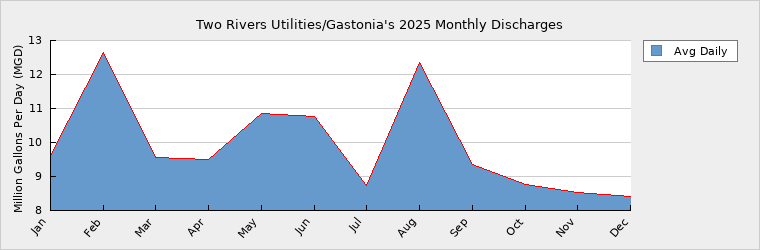
Monthly Discharges
|
Average Daily
Discharge (MGD) |
|
Average Daily
Discharge (MGD) |
|
Average Daily
Discharge (MGD) |
| Jan |
9.6200 |
May |
10.8400 |
Sep |
9.3400 |
| Feb |
12.6600 |
Jun |
10.7700 |
Oct |
8.7600 |
| Mar |
9.5700 |
Jul |
8.7300 |
Nov |
8.5300 |
| Apr |
9.5000 |
Aug |
12.3600 |
Dec |
8.4100 |
Wastewater Permits
| Permit Number |
Type |
Permitted Capacity
(MGD) |
Design Capacity
(MGD) |
Average Annual
Daily Discharge
(MGD) |
Maximum Day Discharge
(MGD) |
Receiving Stream |
Receiving Basin |
| NC0006033 |
WWTP |
4.0000 |
4.0000 |
0.5724 |
1.7900 |
South Fork Catawba River |
South Fork Catawba River (03-2) |
| NC0020184 |
WWTP |
16.0000 |
16.0000 |
7.0110 |
20.3000 |
South Fork Catawba River |
South Fork Catawba River (03-2) |
| NC0040070 |
WTP |
0.7500 |
1.2000 |
0.0000 |
0.0000 |
Unnamed Trib. to Long Creek |
South Fork Catawba River (03-2) |
| NC0074268 |
WWTP |
6.0000 |
6.0000 |
2.3228 |
10.3200 |
Crowders Creek |
Catawba River (03-1) |
| ND0084883 |
WWTP |
0.0000 |
0.0000 |
0.0000 |
0.0000 |
Land Application (SC) |
Catawba River (03-1) |
| WQ0001793 |
WWTP |
0.0000 |
0.0000 |
0.0000 |
0.0000 |
Land Application (NC) |
Catawba River (03-1) |
Land Application Permits: WQ0001793 applied 1,901, dry tons over 130 days in North Carolina & ND0084883 applied 150 dry tons over 16 days in South Carolina. The wastewater from this facility was discharged to Long Creek WWTP for treatment and discharge. Wastewater Interconnections
| Water System |
PWSID |
Type |
Average Daily Amount |
Contract
Maximum (MGD) |
| MGD |
Days Used |
| Belmont |
01-36-015 |
Receiving |
0.2079 |
365 |
0.2800 |
| Bessemer City (Abernethy Creek) |
01-36-025 |
Receiving |
0.4235 |
365 |
0.6083 |
| Bessemer City (Oates Rd) |
01-36-025 |
Receiving |
0.3142 |
365 |
1.0000 |
| Clover |
46-10-006 |
Receiving |
0.6004 |
365 |
0.8667 |
| Dallas - SMV & LCA |
01-36-065 |
Receiving |
0.0503 |
365 |
0.6000 |
| High Shoals |
01-36-075 |
Receiving |
0.0227 |
365 |
0.1000 |
| Kings Mountain |
01-23-020 |
Receiving |
0.0315 |
365 |
1.0000 |
| Lowell |
01-36-060 |
Receiving |
0.0396 |
365 |
0.1500 |
| Ranlo |
01-36-034 |
Receiving |
0.2079 |
365 |
0.4000 |
| Town of McAdenville |
01-36-045 |
Receiving |
0.1241 |
365 |
0.1800 |
| Town of Stanley |
01-36-035 |
Receiving |
0.4104 |
365 |
1.0000 |
There are 2 permitted sewer connections with Bessemer City with separate contracts: Oates Rd with a contract maximum of 1 MGD and an ADF of 0.3142 and Abernethy Creek with a contract maximum of 0.608 MGD and a ADF of 0.4235. Bessemer City reports the totals
.
There are two portions of the Town of Dallas (Spencer Mountain Village Subdivision and Long Creek Apartments) that have been combined.
Kings Mountain has two metering points that have been combined.
Stanley has two metering points that have been combined. 5. Planning
Projections
| |
2025 |
2030 |
2040 |
2050 |
2060 |
2070 |
| Year-Round Population |
96,716 |
100,795 |
111,330 |
122,909 |
135,817 |
150,078 |
| Seasonal Population |
0 |
0 |
0 |
0 |
0 |
0 |
| |
| Residential |
4.5544 |
4.7865 |
5.2872 |
5.8402 |
6.4511 |
7.1259 |
| Commercial |
2.2545 |
2.2708 |
2.5083 |
2.7707 |
3.0605 |
3.3806 |
| Industrial |
0.6278 |
0.6598 |
0.7289 |
0.8051 |
0.8893 |
0.9823 |
| Institutional |
0.6069 |
0.6378 |
0.7046 |
0.7783 |
0.8597 |
0.9496 |
| System Process |
6.1937 |
6.0937 |
5.8937 |
5.6937 |
5.4937 |
5.2937 |
| Unaccounted-for |
3.1104 |
3.3342 |
3.1675 |
3.0091 |
2.8587 |
2.7157 |
A 1.0% yearly increase (compounded annually) in water use projections is based on the projected 1.0% annual population growth in the service area (Gaston County, City of Gastonia, and Cramerton). Demand v/s Percent of Supply
| |
2025 |
2030 |
2040 |
2050 |
2060 |
2070 |
| Surface Water Supply |
75.0000 |
75.0000 |
75.0000 |
75.0000 |
75.0000 |
75.0000 |
| Ground Water Supply |
0.0000 |
0.0000 |
0.0000 |
0.0000 |
0.0000 |
0.0000 |
| Purchases |
0.0000 |
0.0000 |
0.0000 |
0.0000 |
0.0000 |
0.0000 |
| Future Supplies |
0.0000 |
0.0000 |
0.0000 |
0.0000 |
0.0000 |
| Total Available Supply (MGD) |
75.0000 |
75.0000 |
75.0000 |
75.0000 |
75.0000 |
75.0000 |
| Service Area Demand |
17.3477 |
17.7828 |
18.2902 |
18.8971 |
19.6130 |
20.4478 |
| Sales |
1.6307 |
4.2347 |
4.2347 |
4.2347 |
4.2347 |
4.2347 |
| Future Sales |
0.0000 |
0.0000 |
0.0000 |
0.0000 |
0.0000 |
| Total Demand (MGD) |
18.9784 |
22.0175 |
22.5249 |
23.1318 |
23.8477 |
24.6825 |
| Demand as Percent of Supply |
25% |
29% |
30% |
31% |
32% |
33% |

The purpose of the above chart is to show a general indication of how the long-term per capita water demand changes over time. The per capita water demand may actually be different than indicated due to seasonal populations and the accuracy of data submitted. Water systems that have calculated long-term per capita water demand based on a methodology that produces different results may submit their information in the notes field.
Your long-term water demand is 47 gallons per capita per day. What demand management practices do you plan to implement to reduce the per capita water demand (i.e. conduct regular water audits, implement a plumbing retrofit program, employ practices such as rainwater harvesting or reclaimed water)? If these practices are covered elsewhere in your plan, indicate where the practices are discussed here.
We are replacing all water meters in the system with modern meters with AMI functionality. This will allow us to monitor water consumption and help customers identify potential leaks that would normally go undiscovered for extended periods. The new meters should read more accurately as well.
Are there other demand management practices you will implement to reduce your future supply needs? We will continue to use an increasing block rate for residential and irrigation water use to promote conservation. We will continue to use our leak detection equipment to locate and repair leaks. We are replacing all water meters with AMI in the next 3 years.
What supplies other than the ones listed in future supplies are being considered to meet your future supply needs? The water supply at Mountain Island Lake will meet our needs into the future. Our current permit is for an average daily withdrawal of 75 MGD.
How does the water system intend to implement the demand management and supply planning components above? We will continue to use an increasing block rate structure and a full cost recovery rate structure. We will continue our leak detection program and meter testing and change-out programs. We will monitor our per capita water use annually as we update the LWSP in order to work to reduce our per capita water use.
Additional Information
Has this system participated in regional water supply or water use planning? Yes, The City of Gastonia / Two Rivers Utilities participates in the Catawba Wateree Water Management Group and the Catawba Wateree Drought Management Group with other water purveyors in the Catawba Wateree Basin.
What major water supply reports or studies were used for planning? We participated in the development of the Catawba Wateree Integrated Water Resources Plan. By participating in the Water Management Advisory Group and the DMAG, we have access to reports showing the water flow information and the available water supply in the Catawba River above our intake on Mountain Island Lake. We follow the Low Flow Protocol from the DMAG to determine what level of water conservation may be needed.
Please describe any other needs or issues regarding your water supply sources, any water system deficiencies or needed improvements (storage, treatment, etc.) or your ability to meet present and future water needs. Include both quantity and quality considerations, as well as financial, technical, managerial, permitting, and compliance issues: Protection of the water quality in our water supply on Mountain Island Lake. Funding assistance to allow further regionalization of the utility systems in Gaston County. The possible impacts of inter-basin transfer regulations on our water supplies from the Catawba River Basin and Mountain Island Lake. Adequate funding sources that support operations, capital improvements and a comprehensive long-term water supply master plan, in order to maintain and expand the water system to meet the needs of our customers and the future needs of Gaston County.
The Division of Water Resources (DWR) provides the data contained within this
Local Water Supply Plan (LWSP) as a courtesy and service to our customers.
DWR staff does not field verify data. Neither DWR, nor any other party
involved in the preparation of this LWSP attests that the data is completely
free of errors and omissions. Furthermore, data users are cautioned that
LWSPs labeled PROVISIONAL have yet to be reviewed by DWR staff. Subsequent
review may result in significant revision. Questions regarding the accuracy
or limitations of usage of this data should be directed to the water system
and/or DWR.
|