|
The Division of Water Resources (DWR) provides the data contained within this
Local Water Supply Plan (LWSP) as a courtesy and service to our customers.
DWR staff does not field verify data. Neither DWR, nor any other party
involved in the preparation of this LWSP attests that the data is completely
free of errors and omissions. Furthermore, data users are cautioned that
LWSPs labeled PROVISIONAL have yet to be reviewed by DWR staff. Subsequent
review may result in significant revision. Questions regarding the accuracy
or limitations of usage of this data should be directed to the water system
and/or DWR.
1. System Information
Contact Information
Complete
| Water System Name: |
Hickory Catawba System |
|
PWSID: |
01-18-040 |
| Mailing Address: | P.O. Box 398
Hickory, NC 28603 | Ownership: | Municipality |
| |
| Contact Person: | David Cox | Title: | Assistant Public Utilities Director |
| Phone: | 828-323-7689 | Cell/Mobile: | -- |
| |
| Secondary Contact: | William Hamblin | | Phone: | 828-323-7427 |
| Mailing Address: | PO Box 398
Hickory, NC 28603 | Cell/Mobile: | -- |
Distribution System
| Line Type |
Size Range (Inches) |
Estimated % of lines |
| Asbestos Cement |
6 |
5.00 % |
| Cast Iron |
6-8 |
17.00 % |
| Ductile Iron |
6-12 |
10.00 % |
| Galvanized Iron |
2 |
5.00 % |
| Polyvinyl Chloride |
2-12 |
63.00 % |
Programs
Water Conservation
This system has an interconnection with the City of Conover and the City of Newton. 2. Water Use Information
Service Area
| Sub-Basin(s) | % of Service Population |
|---|
| Catawba River (03-1) | 100 % |
|
| County(s) | % of Service Population |
|---|
| Catawba | 100 % |
|
Water Use by Type
| Type of Use |
Metered
Connections |
Metered
Average Use (MGD) |
Non-Metered
Connections |
Non-Metered
Estimated Use (MGD) |
| Residential |
627 |
0.0646 |
0 |
0.0000 |
| Commercial |
47 |
0.0108 |
0 |
0.0000 |
| Industrial |
0 |
0.0000 |
0 |
0.0000 |
| Institutional |
0 |
0.0000 |
0 |
0.0000 |
How much water was used for system processes (backwash, line cleaning, flushing, etc.)? 0.0023 MGD
3. Water Supply Sources
Monthly Withdrawals & Purchases
|
Average Daily
Use (MGD) |
Max Day
Use (MGD) |
|
Average Daily
Use (MGD) |
Max Day
Use (MGD) |
|
Average Daily
Use (MGD) |
Max Day
Use (MGD) |
| Jan |
0.0848 |
|
May |
0.0905 |
|
Sep |
0.1020 |
|
| Feb |
0.0663 |
|
Jun |
0.0842 |
|
Oct |
0.1021 |
|
| Mar |
0.0620 |
|
Jul |
0.0923 |
|
Nov |
0.0776 |
|
| Apr |
0.0615 |
|
Aug |
0.0855 |
|
Dec |
0.0799 |
|
The Catawba System is direct read and billed monthly system, therefore there are no max day readings. There is not a master meter to measure total flow for this system, so readings are taken from individual meter readings of customers.

Water Purchases From Other Systems
| Seller |
PWSID |
Average
Daily Purchased
(MGD) |
Days
Used |
Contract |
Required to
comply with water
use restrictions? |
Pipe Size(s)
(Inches) |
Use
Type |
| MGD |
Expiration |
Recurring |
| City of Hickory |
01-18-010 |
0.0824 |
365 |
0.2250 |
|
Yes |
Yes |
12 |
Regular |
| City of Newton |
01-18-015 |
0.0000 |
0 |
0.0000 |
|
No |
Yes |
12 |
Emergency |
4. Wastewater Information
Monthly Discharges
|
Average Daily
Discharge (MGD) |
|
Average Daily
Discharge (MGD) |
|
Average Daily
Discharge (MGD) |
| Jan |
0.0686 |
May |
0.0729 |
Sep |
0.0804 |
| Feb |
0.0540 |
Jun |
0.0683 |
Oct |
0.0770 |
| Mar |
0.0501 |
Jul |
0.0739 |
Nov |
0.0585 |
| Apr |
0.0615 |
Aug |
0.0707 |
Dec |
0.0656 |
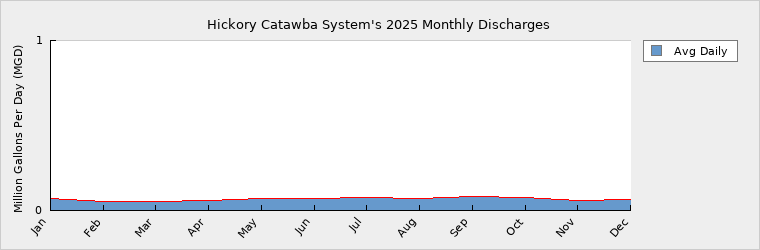
Regarding the difference between avg. monthly flow (0.0668 MGD) and that entered for permit NC0025542 (0.3937 MGD) - only a portion of the plant flows are from this distribution system. Total plant flows are made up of multiple distribution systems. The average daily discharge for permit NC0025542 (0.3937 MGD) is calculated from all collection systems contributing to that facility. There are not flow totalizer meters on the constituent systems. Currently in design phase to expand Hickory Catawba WWTP (NC0025542) to 3.0 MGD.
Wastewater Permits
| Permit Number |
Type |
Permitted Capacity
(MGD) |
Design Capacity
(MGD) |
Average Annual
Daily Discharge
(MGD) |
Maximum Day Discharge
(MGD) |
Receiving Stream |
Receiving Basin |
| NC0025542 |
WWTP |
1.5000 |
1.5000 |
0.3937 |
|
Lyle Creek |
Catawba River (03-1) |
Wastewater discharge may not match due to contributing systems not having master meters. Contributory flows taken from individual water meter reading therefore potential or actual I&I is unaccounted for.
Wastewater Interconnections
| Water System |
PWSID |
Type |
Average Daily Amount |
Contract
Maximum (MGD) |
| MGD |
Days Used |
| Southeastern Catawba County |
20-18-004 |
Receiving |
0.2230 |
365 |
0.7500 |
The Southeast Catawba System discharges 0.2230 MGD. The Town of Catawba discharges the 0.0668 MGD.
5. Planning
Projections
| |
2025 |
2030 |
2040 |
2050 |
2060 |
2070 |
| Year-Round Population |
1,593 |
1,641 |
1,690 |
1,741 |
1,793 |
1,847 |
| Seasonal Population |
0 |
0 |
0 |
0 |
0 |
0 |
| |
| Residential |
0.0646 |
0.0666 |
0.0686 |
0.0706 |
0.0728 |
0.0749 |
| Commercial |
0.0108 |
0.0111 |
0.0115 |
0.0118 |
0.0122 |
0.0125 |
| Industrial |
0.0000 |
0.0000 |
0.0000 |
0.0000 |
0.0000 |
0.0000 |
| Institutional |
0.0000 |
0.0000 |
0.0000 |
0.0000 |
0.0000 |
0.0000 |
| System Process |
0.0023 |
0.0023 |
0.0024 |
0.0025 |
0.0025 |
0.0026 |
| Unaccounted-for |
0.0047 |
0.0048 |
0.0050 |
0.0051 |
0.0053 |
0.0054 |
Demand v/s Percent of Supply
| |
2025 |
2030 |
2040 |
2050 |
2060 |
2070 |
| Surface Water Supply |
0.0000 |
0.0000 |
0.0000 |
0.0000 |
0.0000 |
0.0000 |
| Ground Water Supply |
0.0000 |
0.0000 |
0.0000 |
0.0000 |
0.0000 |
0.0000 |
| Purchases |
0.2250 |
0.2250 |
0.2250 |
0.2250 |
0.2250 |
0.2250 |
| Future Supplies |
0.0000 |
0.0000 |
0.0000 |
0.0000 |
0.0000 |
| Total Available Supply (MGD) |
0.2250 |
0.2250 |
0.2250 |
0.2250 |
0.2250 |
0.2250 |
| Service Area Demand |
0.0824 |
0.0848 |
0.0875 |
0.0900 |
0.0928 |
0.0954 |
| Sales |
0.0000 |
0.0000 |
0.0000 |
0.0000 |
0.0000 |
0.0000 |
| Future Sales |
0.0000 |
0.0000 |
0.0000 |
0.0000 |
0.0000 |
| Total Demand (MGD) |
0.0824 |
0.0848 |
0.0875 |
0.0900 |
0.0928 |
0.0954 |
| Demand as Percent of Supply |
37% |
38% |
39% |
40% |
41% |
42% |

The purpose of the above chart is to show a general indication of how the long-term per capita water demand changes over time. The per capita water demand may actually be different than indicated due to seasonal populations and the accuracy of data submitted. Water systems that have calculated long-term per capita water demand based on a methodology that produces different results may submit their information in the notes field.
Your long-term water demand is 41 gallons per capita per day. What demand management practices do you plan to implement to reduce the per capita water demand (i.e. conduct regular water audits, implement a plumbing retrofit program, employ practices such as rainwater harvesting or reclaimed water)? If these practices are covered elsewhere in your plan, indicate where the practices are discussed here.
No Changes
Are there other demand management practices you will implement to reduce your future supply needs?
What supplies other than the ones listed in future supplies are being considered to meet your future supply needs?
How does the water system intend to implement the demand management and supply planning components above?
Additional Information
Has this system participated in regional water supply or water use planning? No
What major water supply reports or studies were used for planning?
Please describe any other needs or issues regarding your water supply sources, any water system deficiencies or needed improvements (storage, treatment, etc.) or your ability to meet present and future water needs. Include both quantity and quality considerations, as well as financial, technical, managerial, permitting, and compliance issues:
The Division of Water Resources (DWR) provides the data contained within this
Local Water Supply Plan (LWSP) as a courtesy and service to our customers.
DWR staff does not field verify data. Neither DWR, nor any other party
involved in the preparation of this LWSP attests that the data is completely
free of errors and omissions. Furthermore, data users are cautioned that
LWSPs labeled PROVISIONAL have yet to be reviewed by DWR staff. Subsequent
review may result in significant revision. Questions regarding the accuracy
or limitations of usage of this data should be directed to the water system
and/or DWR.
|