|
The Division of Water Resources (DWR) provides the data contained within this
Local Water Supply Plan (LWSP) as a courtesy and service to our customers.
DWR staff does not field verify data. Neither DWR, nor any other party
involved in the preparation of this LWSP attests that the data is completely
free of errors and omissions. Furthermore, data users are cautioned that
LWSPs labeled PROVISIONAL have yet to be reviewed by DWR staff. Subsequent
review may result in significant revision. Questions regarding the accuracy
or limitations of usage of this data should be directed to the water system
and/or DWR.
1. System Information
Contact Information
Complete
| Water System Name: |
Cary |
|
PWSID: |
03-92-020 |
| Mailing Address: | PO Box 8005
Cary, NC 27512-8005 | Ownership: | Municipality |
| |
| Contact Person: | Jamie Revels | Title: | Utilities Director |
| Phone: | 919-469-4303 | Cell/Mobile: | -- |
| |
| Secondary Contact: | Sarah Braman | | Phone: | 919-462-3846 |
| Mailing Address: |
, | Cell/Mobile: | -- |
Distribution System
| Line Type |
Size Range (Inches) |
Estimated % of lines |
| Asbestos Cement |
2-12 |
4.10 % |
| Ductile Iron |
2-54 |
78.00 % |
| Other |
2-54 |
1.10 % |
| Polyvinyl Chloride |
2-30 |
16.80 % |
1. This report includes the combined Town of Cary, Town of Morrisville, and Wake County/RTP South service areas.
2. The number of meters replaced includes potable.
3. The length of distribution lines includes hydrant laterals
4. The number of meters for outdoor use includes potable irrigation only, not reclaimed.
5. Finished water storage excludes WTP clear well storage capacity owned by the Town of Apex.
6. The consistency in total water main lines is due to improved water dataset quality Programs
1. The Town of Cary has a proactive leak detection program that applies to the Cary, Morrisville and RTP South service areas.
2. The Town of Cary conducts annual Water Audits using the AWWA Water Loss Control Committee Water Audit Software v6.0 Water Conservation
1. The Town of Cary manages billing for the combined Cary, Morrisville and RTP South service areas.
2. Reclaimed water service is provided in parts of the Cary, Morrisville and RTP South service areas.
3. Reclaimed water use is based on average day reclaimed water distributed for the year.
4. Reclaimed water use does not include use at the treatment plants, only what is distributed to the system. 2. Water Use Information
Service Area
| Sub-Basin(s) | % of Service Population |
|---|
| Neuse River (10-1) | 67 % |
| Haw River (02-1) | 33 % |
|
| County(s) | % of Service Population |
|---|
| Wake | 96 % |
| Chatham | 4 % |
|
1. Population includes the combined Town of Cary and Town of Morrisville.
2. Relative populations served in each Sub-Basin and each County are based on the numbers and locations of residential water meters. Water Use by Type
| Type of Use |
Metered
Connections |
Metered
Average Use (MGD) |
Non-Metered
Connections |
Non-Metered
Estimated Use (MGD) |
| Residential |
70,572 |
10.3000 |
0 |
0.0000 |
| Commercial |
4,076 |
3.7000 |
0 |
0.0000 |
| Industrial |
45 |
0.5000 |
0 |
0.0000 |
| Institutional |
407 |
0.3000 |
0 |
0.0000 |
How much water was used for system processes (backwash, line cleaning, flushing, etc.)? 4.2600 MGD
1. Metered Connection is a meter count including irrigation meters for billed customers (not including metered system process water)
2. Reported system process water includes only:
- System process water at the WTP attributed to the combined Town of Cary, Town of Morrisville, and Wake County/RTP South service areas.
- Water used in flushing the distribution system at fixed, metered locations.
- Estimated Flushing from our Work Order Management System
- Bulk Potable Use included in Commercial use Water Sales
| Purchaser |
PWSID |
Average
Daily Sold
(MGD) |
Days
Used |
Contract |
Required to
comply with water
use restrictions? |
Pipe Size(s)
(Inches) |
Use
Type |
| MGD |
Expiration |
Recurring |
| City of Durham |
03-32-010 |
0.1333 |
1 |
0.0000 |
2028 |
Yes |
Yes |
16 |
Emergency |
| City of Raleigh |
03-92-010 |
0.0000 |
0 |
0.0000 |
2032 |
Yes |
No |
24 |
Emergency |
| Orange Water and Sewer Authority |
03-68-010 |
0.0000 |
0 |
0.0000 |
2029 |
Yes |
Yes |
0 |
Emergency |
| RDU |
00-00-000 |
0.2770 |
365 |
0.4000 |
2033 |
Yes |
No |
16 |
Regular |
| Town of Holly Springs |
03-92-050 |
0.0000 |
0 |
0.0000 |
2045 |
Yes |
Yes |
16 |
Emergency |
1. Contracts with Durham, OWASA, Holly Springs, and Raleigh are mutual aid agreements. Water volumes transferred will depend upon system capacities at the time.
2. Sales to OWASA are conveyed through City of Durham.
3. Average daily sales amount is based on finished water metered at the interconnection.
Cary confirms 0.1333 MGD in one day of sales to Durham. 3. Water Supply Sources
Monthly Withdrawals & Purchases
|
Average Daily
Use (MGD) |
Max Day
Use (MGD) |
|
Average Daily
Use (MGD) |
Max Day
Use (MGD) |
|
Average Daily
Use (MGD) |
Max Day
Use (MGD) |
| Jan |
18.3000 |
20.8300 |
May |
21.2100 |
24.2600 |
Sep |
24.1900 |
26.4000 |
| Feb |
17.9900 |
19.5200 |
Jun |
22.4200 |
26.5200 |
Oct |
22.7500 |
25.7200 |
| Mar |
19.2000 |
21.0100 |
Jul |
23.6800 |
29.6800 |
Nov |
19.8800 |
22.5100 |
| Apr |
20.1200 |
23.5100 |
Aug |
22.6800 |
26.7500 |
Dec |
18.0500 |
25.0700 |
1. Water withdrawals include the combined Town of Cary, Town of Morrisville, and Wake County/RTP South service areas.
2. These values include withdrawals for water sales. 
Surface Water Sources
| Stream |
Reservoir |
Average Daily Withdrawal |
Maximum Day
Withdrawal (MGD) |
Available Raw
Water Supply |
Usable On-Stream
Raw Water Supply
Storage (MG) |
| MGD |
Days Used |
MGD |
* Qualifier |
| Haw River |
B. Everett Jordan Lake |
20.8900 |
365 |
29.6800 |
35.6000 |
SY50 |
5,313.0000 |
* Qualifier: C=Contract Amount, SY20=20-year Safe Yield, SY50=50-year Safe Yield, F=20% of 7Q10 or other instream flow requirement, CUA=Capacity Use Area Permit
Surface Water Sources (continued)
| Stream |
Reservoir |
Drainage Area
(sq mi) |
Metered? |
Sub-Basin |
County |
Year
Offline |
Use
Type |
| Haw River |
B. Everett Jordan Lake |
1,690 |
Yes |
Haw River (02-1) |
Chatham |
|
Regular |
1. The raw withdrawal represents withdrawal for the Cary Service Area (including Morrisville, RDU, RTP-South), not Apex.
2. Water is drawn from the Haw, but a portion of the system use occurs in the Neuse Basin.
3. Note that the annual withdrawal includes volume transferred to municipalities that have their own available allocations.
Water Purchases From Other Systems
| Seller |
PWSID |
Average
Daily Purchased
(MGD) |
Days
Used |
Contract |
Required to
comply with water
use restrictions? |
Pipe Size(s)
(Inches) |
Use
Type |
| MGD |
Expiration |
Recurring |
| City of Durham |
03-32-010 |
0.0000 |
0 |
0.0000 |
2028 |
Yes |
Yes |
16 |
Emergency |
| City of Raleigh |
03-92-010 |
0.0000 |
0 |
0.0000 |
2032 |
Yes |
No |
24 |
Emergency |
| Orange Water and Sewer Authority |
03-68-010 |
0.0000 |
0 |
0.0000 |
2029 |
Yes |
Yes |
0 |
Emergency |
| Town of Holly Springs |
03-92-050 |
0.0000 |
0 |
0.0000 |
2045 |
No |
No |
16 |
Emergency |
1. Contracts with City of Durham, OWASA, Holly Springs, and Raleigh are mutual aid agreements. Water volumes transferred will depend upon system capacities and needs at the time.
2. Purchases from OWASA are conveyed through City of Durham.
3. Average daily purchased amount is based on finished water metered at the interconnection. Water Treatment Plants
| Plant Name |
Permitted Capacity
(MGD) |
Is Raw Water Metered? |
Is Finished Water Ouput Metered? |
Source |
| Cary-Apex |
56.0000 |
Yes |
Yes |
B. Everett Jordan Lake |
1. The Cary-Apex Water Treatment Facility is co-owned by Cary and Apex, and serves the Cary, Apex, Morrisville, and RTP South service areas.
2. The reported plant capacity is for the entire plant, and the expansion to 56 mgd was completed in 2018. 4. Wastewater Information
Monthly Discharges
|
Average Daily
Discharge (MGD) |
|
Average Daily
Discharge (MGD) |
|
Average Daily
Discharge (MGD) |
| Jan |
18.4900 |
May |
19.7200 |
Sep |
18.1200 |
| Feb |
20.3800 |
Jun |
19.4100 |
Oct |
18.3900 |
| Mar |
19.7600 |
Jul |
19.7200 |
Nov |
18.7100 |
| Apr |
19.5300 |
Aug |
21.6000 |
Dec |
19.1100 |
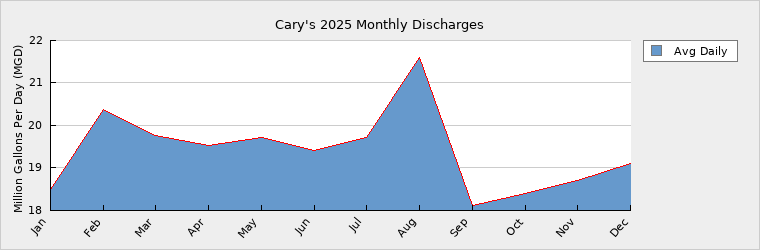
1. Wastewater information includes the combined Town of Cary, Town of Morrisville, and Wake County/RTP South service areas.
2. Monthly Discharge does not include reclaimed water.
3. The number of septic systems in the Towns of Cary, Morrisville, and RTP South is unknown.
4. WWRWRF effluent includes wastewater from Apex.
5. A study is currently underway evaluating an expansion of the Western Wake Regional WRF. Wastewater Permits
| Permit Number |
Type |
Permitted Capacity
(MGD) |
Design Capacity
(MGD) |
Average Annual
Daily Discharge
(MGD) |
Maximum Day Discharge
(MGD) |
Receiving Stream |
Receiving Basin |
| NC0048879 |
WWTP |
12.0000 |
12.0000 |
6.3000 |
12.1000 |
Crabtree Creek |
Neuse River (10-1) |
| NC0065102 |
WWTP |
16.0000 |
12.8000 |
5.7000 |
10.2000 |
Middle Creek |
Neuse River (10-1) |
| NC0088846 |
WWTP |
18.0000 |
18.0000 |
7.4000 |
12.1000 |
Cape Fear River |
Cape Fear River (02-3) |
Wastewater Interconnections
| Water System |
PWSID |
Type |
Average Daily Amount |
Contract
Maximum (MGD) |
| MGD |
Days Used |
| Durham County WWTP |
00-00-000 |
Receiving |
0.0500 |
1 |
5.0000 |
On 11/26/25 0.05 MGD was received by Durham County. This flow is incorporated into the NCWRF reported values. 5. Planning
Projections
| |
2025 |
2030 |
2040 |
2050 |
2060 |
2070 |
| Year-Round Population |
227,281 |
255,553 |
315,845 |
358,645 |
379,636 |
400,627 |
| Seasonal Population |
0 |
0 |
0 |
0 |
0 |
0 |
| |
| Residential |
10.3000 |
12.1500 |
15.2000 |
17.2500 |
18.3200 |
19.4000 |
| Commercial |
3.7000 |
3.7600 |
5.3000 |
6.3200 |
6.9200 |
7.5300 |
| Industrial |
0.5000 |
0.5600 |
0.6000 |
0.6300 |
0.6600 |
0.7000 |
| Institutional |
0.3000 |
0.4200 |
0.5900 |
0.7000 |
0.7700 |
0.8400 |
| System Process |
4.2600 |
5.5800 |
6.9800 |
7.5900 |
7.9400 |
7.9800 |
| Unaccounted-for |
1.5526 |
0.8900 |
1.0600 |
1.1300 |
1.1100 |
1.0900 |
Regarding the 81% projected demand-to-supply ratio in 2050, we are aware of it and do have plans to do some system looping to address some of our non-revenue flushing. We also know that our projections represent a particular expectation of growth and anticipate another iteration of our Long Range Plan in coming years (we aim to do so every ~5 years) so we’re keeping our eye on the horizon as well. Future Supply Sources
| Source Name |
PWSID |
Source Type |
Additional Supply |
Year Online |
Year Offline |
Type |
| Jordan Lake Round 5 |
03-92-020 |
Surface |
2.7000 |
2040 |
|
Regular |
| Process Water Recycling |
03-92-002 |
Surface |
2.5300 |
2030 |
|
Regular |
| Process Water Recycling |
03-92-020 |
Surface |
0.6500 |
2040 |
|
Regular |
| Process Water Recycling |
03-92-020 |
Surface |
0.4500 |
2050 |
|
Regular |
| Process Water Recycling |
03-92-020 |
Surface |
0.2100 |
2060 |
|
Regular |
1.The future round of Jordan Lake water supply storage allocation requests are based on projected demands for year 2070.
2. The additional water supply storage allocation amount is consistent with the Cary Long Range Water Resources Plan (HDR, 2025) as well as the draft Regional Water Supply Plan being developed by the Triangle Water Supply Partnership (formerly the Jordan Lake Partnership).
3. Recycling of process water use at the Cary Apex WTF is included as a potentially future water supply and is approximated as 10% of the forecasted Raw Water Supply up to 5 MGD. The values provided are estimated and reflect 77% of the potential recovery based on Cary’s ownership share of CAWTF. Demand v/s Percent of Supply
| |
2025 |
2030 |
2040 |
2050 |
2060 |
2070 |
| Surface Water Supply |
35.6000 |
35.6000 |
35.6000 |
35.6000 |
35.6000 |
35.6000 |
| Ground Water Supply |
0.0000 |
0.0000 |
0.0000 |
0.0000 |
0.0000 |
0.0000 |
| Purchases |
0.0000 |
0.0000 |
0.0000 |
0.0000 |
0.0000 |
0.0000 |
| Future Supplies |
2.5300 |
5.8800 |
6.3300 |
6.5400 |
6.5400 |
| Total Available Supply (MGD) |
35.6000 |
38.1300 |
41.4800 |
41.9300 |
42.1400 |
42.1400 |
| Service Area Demand |
20.6126 |
23.3600 |
29.7300 |
33.6200 |
35.7200 |
37.5400 |
| Sales |
0.2774 |
0.4000 |
0.4000 |
0.4000 |
0.4000 |
0.4000 |
| Future Sales |
0.0000 |
0.0000 |
0.0000 |
0.0000 |
0.0000 |
| Total Demand (MGD) |
20.8900 |
23.7600 |
30.1300 |
34.0200 |
36.1200 |
37.9400 |
| Demand as Percent of Supply |
59% |
62% |
73% |
81% |
86% |
90% |

The purpose of the above chart is to show a general indication of how the long-term per capita water demand changes over time. The per capita water demand may actually be different than indicated due to seasonal populations and the accuracy of data submitted. Water systems that have calculated long-term per capita water demand based on a methodology that produces different results may submit their information in the notes field.
Your long-term water demand is 45 gallons per capita per day. What demand management practices do you plan to implement to reduce the per capita water demand (i.e. conduct regular water audits, implement a plumbing retrofit program, employ practices such as rainwater harvesting or reclaimed water)? If these practices are covered elsewhere in your plan, indicate where the practices are discussed here.
No Changes
Are there other demand management practices you will implement to reduce your future supply needs? Cary's Long-Range Water Resources Plan (HDR, 2025) includes an evaluation of Cary's water conservation approaches.
What supplies other than the ones listed in future supplies are being considered to meet your future supply needs? Cary's Long-Range Water Resources Plan (HDR, 2025) includes an evaluation of water supply alternatives.
How does the water system intend to implement the demand management and supply planning components above? 1. The Town of Cary has a mature water conservation program that applies to the combined Cary, Morrisville and RTP South service areas and has been operating since 1996.
2. The program has firmly established a culture of conservation and valuing water resources within the communities.
Additional Information
Has this system participated in regional water supply or water use planning? Yes, Yes, The Town of Cary, Town of Morrisville, and Wake County/RTP South are active members of the Triangle Water Supply Partnership. The Partners are committed to working collaboratively to enhance the sustainability and security of the region's water supply resources through conservation and efficiency, interconnection, and coordinated planning and development of this critical resource. The TWP is currently working on a Regional Water Supply Plan, with completion expected later in 2026.
What major water supply reports or studies were used for planning? Triangle J Council of Governments (TJCOG), 2014. Triangle Regional Water Supply Plan: Volume II – Regional Water Supply Alternatives Analysis.
CH2M Hill and Brown and Caldwell, January 2013. Long Range Water Resources Plan. Prepared for Towns of Cary, Apex and Morrisville and Wake County.
Triangle J Council of Governments (TJCOG), 2012. Triangle Regional Water Supply Plan: Volume I – Regional Needs Assessment.
CH2M Hill, 2010. Town of Cary Water Use Analysis TM. Prepared for Town of Cary, North Carolina.
CH2M Hill, 2009. Town of Cary Water Distribution System Master Plan. Prepared for Town of Cary, North Carolina.
Jacobs Engineering, 2018. Long Range Water Resource Plan Update. Prepared for Towns of Cary, Apex and Morrisville and Wake County.
Central Pines Regional Council (CPRC), 2024. Triangle Regional Water Supply Plan - Phase 1 - Regional assessment
HDR, 2024. Cary Long Range Water Resources Plan: Water Demand and Wastewater Flow Forecast TM
HDR, 2025. Cary Long Range Water Resources Plan. Prepared for Towns of Cary, Apex and Morrisville and Wake County.
Please describe any other needs or issues regarding your water supply sources, any water system deficiencies or needed improvements (storage, treatment, etc.) or your ability to meet present and future water needs. Include both quantity and quality considerations, as well as financial, technical, managerial, permitting, and compliance issues:
The Division of Water Resources (DWR) provides the data contained within this
Local Water Supply Plan (LWSP) as a courtesy and service to our customers.
DWR staff does not field verify data. Neither DWR, nor any other party
involved in the preparation of this LWSP attests that the data is completely
free of errors and omissions. Furthermore, data users are cautioned that
LWSPs labeled PROVISIONAL have yet to be reviewed by DWR staff. Subsequent
review may result in significant revision. Questions regarding the accuracy
or limitations of usage of this data should be directed to the water system
and/or DWR.
|